
Camp on Durable Surfaces? Changes to the "Single Plant Rule" Could Lead to Concentrated Impacts (And Lower Costs) For New Renewables.
A bill to change the "single plant rule" for renewable energy siting passed out of the Vermont House last week.

On my first backpacking trip, circa age 11 and through the auspices of summer camp (my family Did Not Camp), I learned the principles of “Leave No Trace” backpacking. Principle 2 is: “Travel and camp on durable surfaces,” which “include established trails [and] campsites ….” But, the text goes on, “in undisturbed areas, disperse use to prevent the creation of campsites and trails.”
In the unreliable halls of memory, this principle morphed into the wise-sounding not-quite paradox of “In some cases, concentrate impact; in others disperse it,” and was captured in twin images of my backpacking group walking single file on an established path but spreading out to cross an undisturbed meadow.
Twenty five years later, I often find it useful to look at environment and land-use laws through the lens of whether they are concentrating or dispersing impacts, or both in different ways. Smart-growth planning laws? Largely about concentrating the impacts of permanent land conversion to minimize fragmentation of forest blocks and other ecosystems. Standards that put a numeric limit on the pollutants discharged by a single plant into the air or water? These can be viewed as spreading out pollution across more plants and therefore a wider area.
This is not a full-throated endorsement of principle 2 in even a backpacking context. (Among other things, LNT is arguably grounded in the “fortress conservation” mindset of “nature as other,” with all sorts of problematic historical and philosophical baggage). Applied out of context to things like industrial pollution, concentrating impacts can run counter to the principles of environmental justice that have been an important corrective to early environmentalists’ blind spots.
But at a 30,000-foot level, keeping in mind the tension between concentrating and dispersing impacts pays dividends, as long as one remembers that the “best” approach for any particular initiative is a) subjective and b) depends on many factors, including the environmental attributes one is trying to protect, what the particular impacts are, and how those impacts operate across space and time.
That long and dithering introduction is all by way of teeing up a measure that is moving quickly through the Vermont legislature and reflects this very tension. H. 710, which passed the full House on February 19, is a technical amendment to the state’s policies that promote distributed, small-scale, renewable generation. Distributed generation serves several arguably more integral purposes than dispersing environmental impacts of the generation, some of which are enumerated in state law. These include reducing the need for new transmission lines, increasing resiliency of the grid, and (depending on the ownership structures) promoting local control of energy. But promoting distributed generation is a clear example of a policy towards the “disperse impacts” end of the spectrum.
H. 710 changes these policies in a way that could lead to greater concentration of visual and environmental impact among this subset of projects, in exchange for greater affordability for both project developers and ratepayers and, perhaps, lower overall environmental impacts.
It does so by changing the so-called “single plant rule.” As background: the state has created multiple policies that provide explicit incentives for small renewable installations. One is the net-metering program, which directs utilities to compensate, at above wholesale rates, excess generation from wind and solar arrays up to 500 kW in the form of billing credits that can be taken off of a future bill for up to one year. Another is Tier II of the Renewable Energy Standard (RES), which requires electric utilities to source a certain percentage of their power (rising to 20% by no later than 2035) from new, in-state renewable plants smaller than 5 MW, making the renewable energy credits (RECs) from these plants more valuable than they otherwise would be.
(A third relevant program, known as Standard Offer, has been fully subscribed and is not, without a change in statute, accepting new applications, so I won’t spend more time on it here).
Because there’s a size limit baked into eligibility for each of these incentives, the legislature wrote a definition of “plant” that was meant to prevent a developer of new renewables from gaming the system by artificially breaking a larger project into several small “plants” right next to each other and claiming the incentive for each one. (Long-time readers of this newsletter will remember that they did something very similar years ago to try to prevent gaming of the exceptions to Act 250 jurisdiction for smaller housing projects through the “10-5-5” rule, which has arguably created more problems than it’s solved).
As it stands, the statute creates a multi-part test that the Public Utility Commission (PUC) must apply to determine whether two projects using the same generation technology on the same parcel or adjacent parcels are actually a “single plant,” with factors including common ownership, use of shared infrastructure like roads or electrical control equipment, and how close in space and time the projects were built to each other. But the law doesn’t tell the PUC how much weight to give to any one of these factors.
Both the PUC and renewable energy advocates have criticized this definition as too subjective and time-intensive to apply. “The same-project analysis includes 1) proximity, (2) common ownership, and (3) contiguity in time of construction. None of the three concepts is defined in the statute, and therefore the current definition requires the Commission to conduct complex factual and legal analyses,” the PUC wrote in its recommendation that formed the basis of the proposed amendments in H. 710.
And in a 2023 report, Renewable Energy Vermont, a trade association for renewables in the state, compiled several examples of situations where the single plant rule led to denial or long delays for relatively straightforward projects, like two neighbors independently trying to build net-metering arrays.
Under the proposed new definition, plants using the same technology on the same parcel or adjacent parcels will be considered a “single plant,” regardless of when each was constructed, unless:
i) They’re individual net-metering projects on adjacent parcels that serve different customers, each with their own meter, OR
ii) They’re individual net metering projects on the same parcel but serving separate meters/customers in a “common interest community” like a coop or HOA OR
iii) (and this is the tricky one): They have separate points of interconnection to the local transmission or distribution wires, AND they’re neither (a) a Standard Offer plant and a net-metering plant nor (b) two net-metering plants or two standard offer plants that, combined, exceed the relevant threshold.
One could puzzle over exception (iii) for years, but in this case a diagram is worth a thousand words: Check out this presentation from the PUC’s general counsel about what would and would not be allowed under the third exception. (A note on the diagram: PPA stands for “Power Purchase Agreement,” meaning these would be plants likely built with a long-term destination for the power already contracted for. Here the PPA projects are labeled as 5 MW because that’s the ceiling for a project that qualifies for Tier II of the RES).
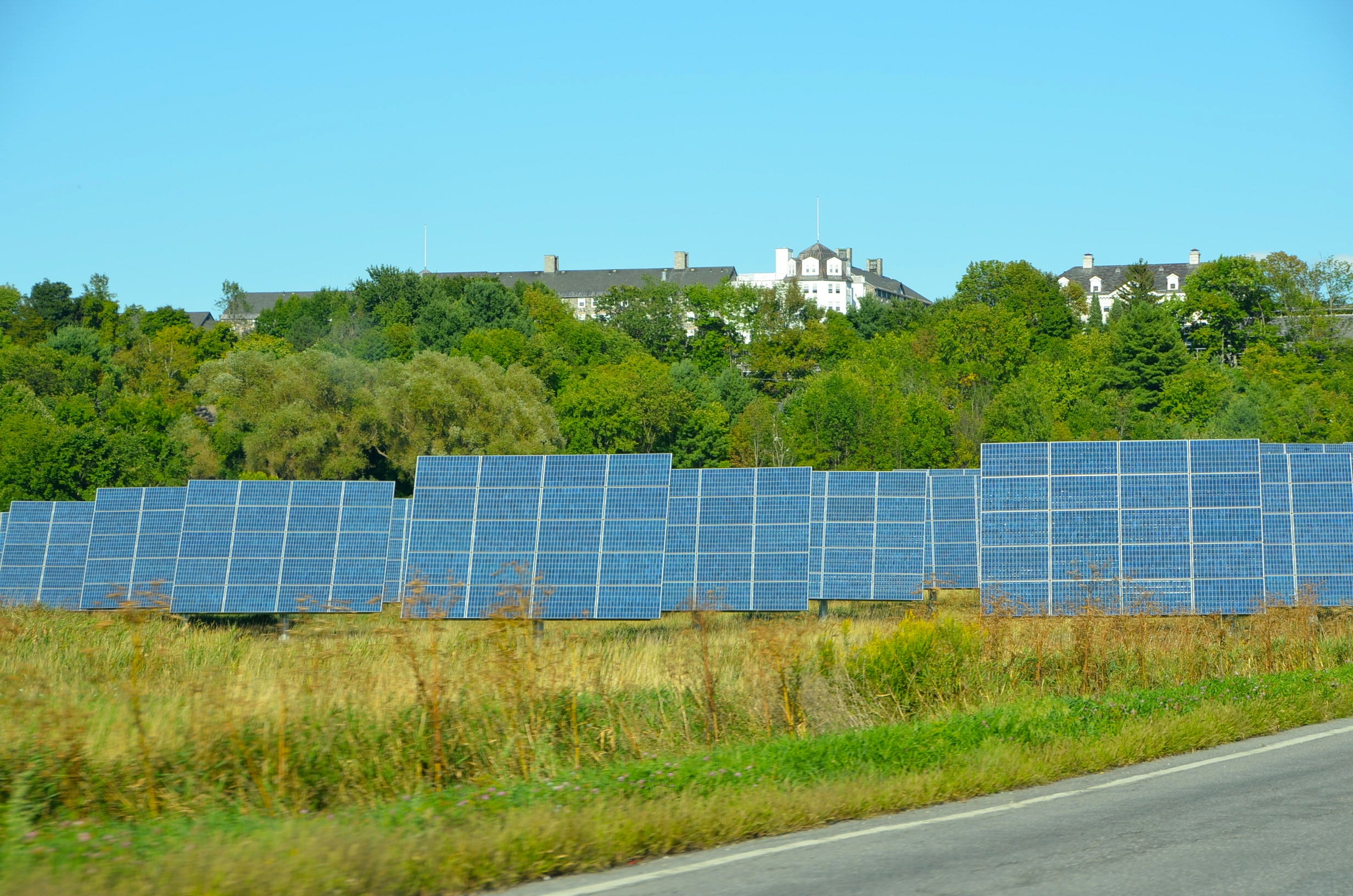
Exception (iii) is the truly significant change in these proposed amendments. This change will enable, for example, two 5 MW solar plants to more easily be built on adjacent parcels of land while still qualifying for Tier II. A 5 MW solar farm is already quite large—likely taking up at least 25 acres, based on information from the Solar Energy Industries Association.
Backers of the change say that co-locating these projects to take advantage of shared roads and other infrastructure can bring down the cost to build them, which in turn can reduce how much utilities and ultimately ratepayers pay to purchase power from them. It can also reduce the overall environmental impacts of more fragmented projects, which would each have their own roads and other infrastructure, buffer areas, etc.—and allow developers to take full advantage of already altered areas like former gravel pits.
The potential downside could be more concentrated environmental and visual impacts, including on land that is or has been used for farming. Those impacts will still be studied, however, and see opportunities for mitigation through the Certificate of Public Good and other state permitting processes.
In fact, it does not appear there’s anything in the proposed text limiting developers to building just two 5-MW projects next to each other—they could build more than two and each would qualify as a separate plant for Tier II purposes, as long as it had its own interconnection point.
Instead, Peter Sterling of Renewable Energy Vermont, who testified in favor of changing the single plant rule, told me that in addition to state permitting, grid constraints, economics, and the utilities’ gatekeeping role would likely prevent this concentration of generation that is meant to be dispersed from getting out of hand.
“A utility always has preliminary say over where something is sited. Because if the utility doesn’t think that it will work for the grid they’ve got, they can say, ‘if you want to put that five-megawatt plant next to the other one, here’s the number of grid upgrades that would be necessary to interconnect that.’ If it’s a lot of money, the project wouldn’t pencil out,” Sterling said.
Utilities currently source most of their Tier II credits from net-metering installations, according to a recent presentation from the Department of Public Service. However, the increased Tier II requirement coupled with the elimination of federal tax credits for rooftop solar and the recent end to Vermont’s group (off-site) net metering program (there have been proposals for a successor but none have taken off), means we’ll likely see more of these 5 MW or smaller arrays going up. And, thanks to these changes, it’s likely that more of them will be right next to each other.
H. 710 is now before the Senate Committee on Finance for further testimony and markups.